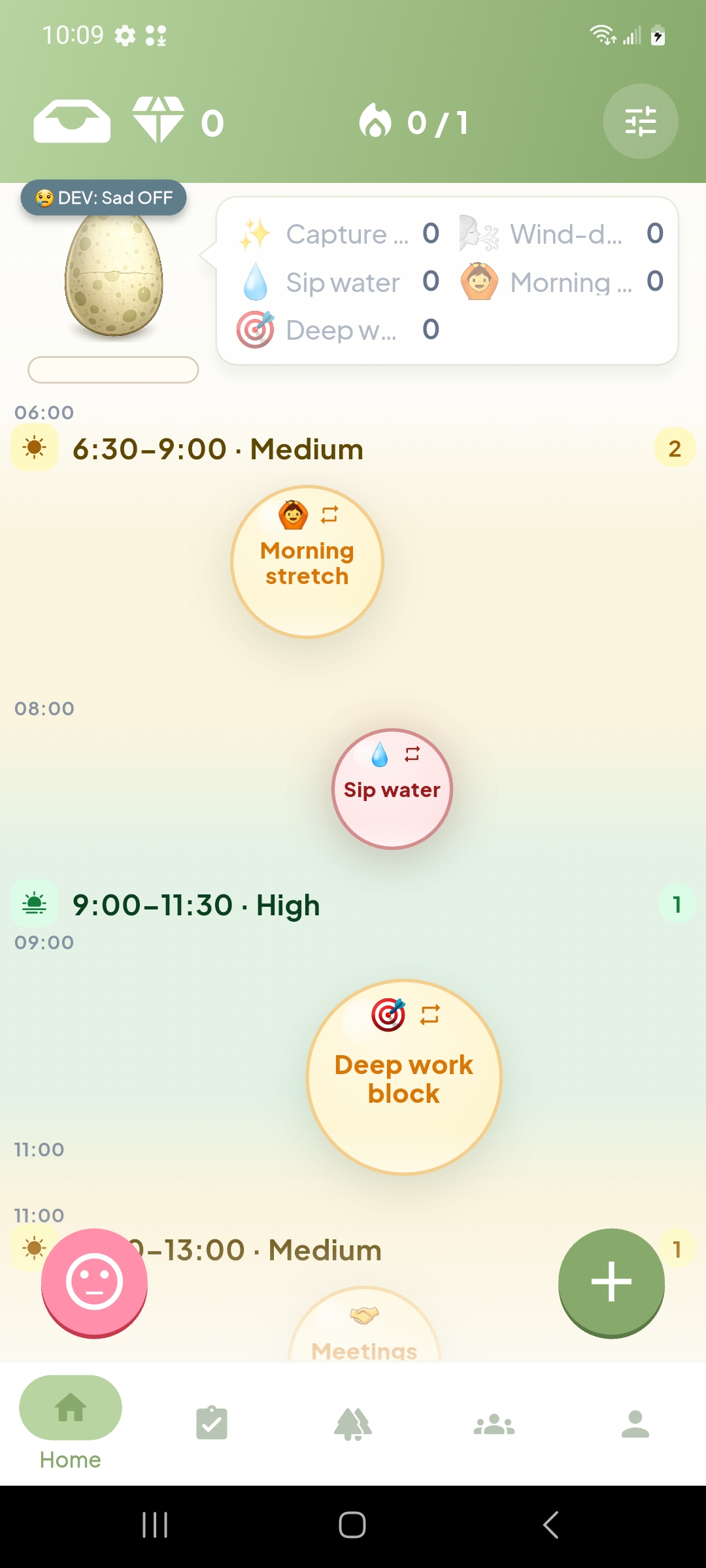
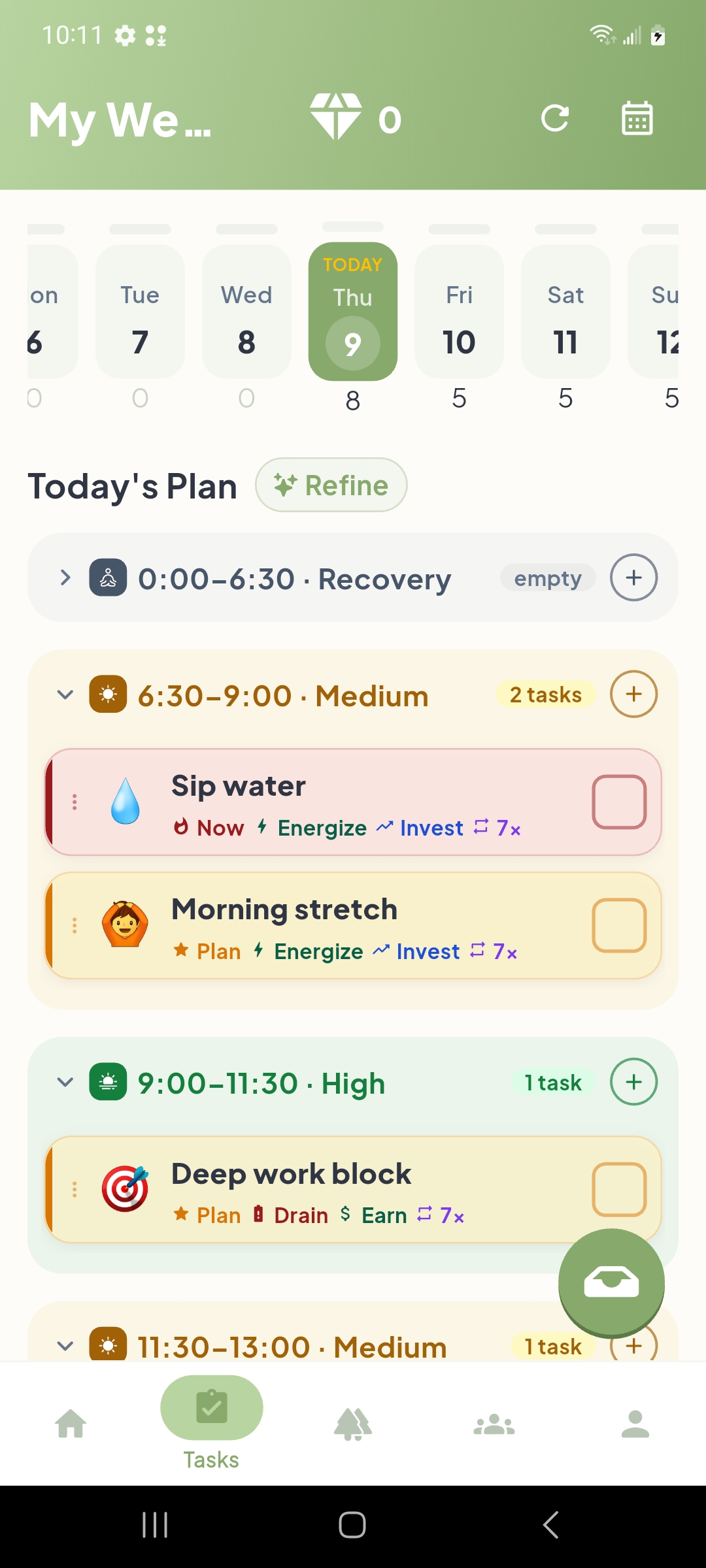
Your 3 p.m. slump isn't a willpower problem. It's biology.
Your brain runs on a cycle. Energy rises. Energy falls. It repeats, every single day.
Most productivity advice ignores this. It treats every hour like every other hour. That's the mistake.
Energy-based scheduling fixes it. Instead of asking "when am I free?", you ask "when am I actually capable of this?"
That one shift changes everything: fewer stalled tasks, fewer wasted mornings, less burnout.
What Is Energy-Based Scheduling?
Energy-based scheduling means matching the difficulty of a task to your current energy level, not just to an open slot on your calendar.
Deep, demanding work goes in your peak-energy windows. Light, routine work goes in your low-energy windows. Rest goes wherever your body asks for it.
It's the opposite of traditional time management. Time management asks how long a task takes. Energy management asks how much capacity a task needs — and whether you have that capacity right now.
The Science Behind It
This isn't a productivity trend. It's grounded in real research on how the brain works.
Ultradian rhythms. Your body moves through 90-minute cycles of rising and falling alertness, all day long. Sleep researcher Nathaniel Kleitman first documented this pattern. It doesn't stop when you wake up — it just shifts from sleep cycles to focus cycles.
Decision fatigue. Every choice you make draws down a limited mental resource. Psychologist Roy Baumeister's research on ego depletion showed that willpower and decision-making quality decline with use, like a battery running low over the course of a day.
Performance researchers Jim Loehr and Tony Schwartz made the case plainly: energy, not time, is the fundamental currency of high performance. You can have all the time in the world and still produce nothing, if your energy is gone.
Chronotype variability. Not everyone peaks at the same hour. Some people are sharpest at 9 a.m. Others don't hit their stride until early evening. A one-size-fits-all schedule ignores this entirely.
Flow state. Psychologist Mihaly Csikszentmihalyi found that our best work happens in a specific zone — challenge matched to skill, at the right energy level. Miss that window, and flow doesn't happen, no matter how hard you try.
Put together, the research says the same thing: your calendar should follow your energy, not the other way around.
Why Time-Blocking Alone Fails
Time-blocking is popular. It's also incomplete.
You can protect four "deep work" hours on your calendar. But if those hours land during your post-lunch dip, you'll stare at the screen and get little done.
The block was there. The time was there. The capacity wasn't.
This is why so many productivity systems work great for a week, then quietly fall apart. They manage the clock. They don't manage the fuel.
For anyone with ADHD, this gap is even more costly. Energy and focus are already unpredictable. A schedule that assumes flat, constant energy sets you up to fail before the day even starts.
How to Build an Energy-Based Schedule
You don't need a complicated system. You need four steps, repeated daily.
- Track your energy for one week. Rate it low, medium, or high every few hours. Patterns show up fast.
- Sort your tasks by demand, not just duration. A 20-minute email can be high-demand. A 2-hour cleanup can be low-demand.
- Match high-demand tasks to your peak windows. Writing, planning, and problem-solving belong in your best hours.
- Save low-demand tasks for your dips. Filing, replying, tidying — these fit naturally into lower-energy stretches.
Small shifts count. Moving even one task to match your energy can change how your whole day feels.
Common Mistakes That Cause Burnout
- Scheduling meetings during peak hours. This burns your best mental fuel on things that rarely need it.
- Ignoring your dip. Fighting your low-energy window instead of working with it just adds stress on top of fatigue.
- Treating rest as optional. Recovery isn't a reward for finishing. It's part of the system that lets you perform again tomorrow.
- Copying someone else's peak hours. Your chronotype is yours. A schedule built for a "morning person" won't work if you're not one.
Frequently Asked Questions
What is energy-based scheduling? Energy-based scheduling is planning your day around your natural energy levels instead of just the clock. Demanding tasks go in high-energy windows. Easy tasks go in low-energy windows.
How is energy management different from time management? Time management asks how long a task takes. Energy management asks how much mental capacity a task needs, and whether you have that capacity right now.
What causes energy dips during the day? Energy dips come from natural ultradian rhythms and decision fatigue. Cognitive resources get used up with each demanding task and need time to recover.
Does energy-based scheduling help with burnout? Yes. Matching task difficulty to energy level reduces the strain of forcing hard work during low-capacity hours, which is a major driver of burnout over time.
Is energy-based scheduling helpful for ADHD? Yes, often more than standard time-blocking. ADHD involves less predictable energy and focus, so a schedule built around real energy levels tends to fit better than one built around fixed time slots.
The Bottom Line
Time was never the real problem. Energy is.
Once you schedule around your actual energy, work stops feeling like a fight. That's the whole idea behind energy-based planning — and it's why we built ZoBud around it from day one.